
Build an insurance agency that gets stronger without owner rescue.
MyECOS360 helps independent agencies identify the constraint limiting the business, make one accountable operating decision, and keep it alive through a repeatable cadence.
Free · preliminary result on screen · no email required
The agency looks busy. It is also fragile.
Everything routes to the owner
Numbers without decisions
More activity, same ceiling
What it looks like when it works

The owner leaves on time
Escalations have an owner who is not you, and the work keeps moving when you step away.

Clients stay for years
Reviews happen on a calendar, so retention is a practice instead of a hope.

The team runs the cadence
A short daily huddle and a weekly review keep one decision alive at a time.
More activity is not more strength.
An agency is a set of operating systems, and at any moment one of them is constraining the others. Buying leads doesn’t help when the funnel leaks. Hiring doesn’t help when no decisions are delegated. Working harder doesn’t help when the work itself routes everything back to the owner. MyECOS360 is built on a simpler discipline: find the constraint, fix the constraint, verify it moved — then find the next one.
The six operating systems
Every agency runs all six — deliberately or by accident. The framework makes them explicit so the current constraint can be found and fixed.
- Producer Leverage
Protect high-value time and reduce owner rescue.
- Focused Book
Choose the clients, products, and risks worth systemizing.
- Lead Engine
Create and measure the path from lead source to retained client.
- Service & Persistency
Keep what the agency earns.
- Leadership Bench
Move routine decisions downward safely.
- Culture & Continuity
Make promises and knowledge survive pressure and absence.

System 1
Producer Leverage

System 2
Focused Book

System 3
Lead Engine
System 4
Service & Persistency

System 5
Leadership Bench
System 6
Culture & Continuity
How it works: Diagnose → Decide → Run → Review
Step 1
Diagnose
Score the six systems and find the one constraining the others right now.
Step 2
Decide
Convert the evidence into one accountable decision — one metric, one owner, one review date.
Step 3
Run
Work the countermeasure through the daily and weekly cadence, not as a someday project.
Step 4
Review
On the review date, close the loop: did the metric move? Keep, adjust, or pick the next constraint.
- Measure
- Interpret
- Find cause
- Choose action
- Set review date
Then the loop repeats. The center question of every metric: what does this number mean, and what are we going to change because of it?
Where is your constraint?
Twelve questions, two per system. “Unknown — I don’t track this” is a valid answer and is treated as a data gap, not a failure. Your preliminary constraint pattern appears on screen immediately — email is only needed if you want it saved.
- A likely current constraint, with stated confidence
- Evidence supplied vs. missing — your data gaps, named
- One metric to watch and one countermeasure to test
- One owner and one review date to assign
Decisions stay alive on a cadence
Workbooks and strategy sessions fail as one-time events. The framework runs on recurring speeds — each one with a specific job, so improvements survive contact with a busy quarter.
- DailyProtect priorities and surface immediate risk.
- WeeklyReview scorecard exceptions, issues, and decisions.
- MonthlyInspect trends, causes, and countermeasures.
- QuarterlyRe-score the six systems; choose the next constraint.
- YearlyReset assumptions, capacity, focus, and direction.
Evidence over adjectives
MyECOS360 labels operational evidence rather than guessing: Verified, Estimated, Unknown, or Data Gap. A data gap is not a failure — it is an operating signal, and often the first constraint worth removing. The same standard applies to this website: our editorial and evidence policy governs every claim we publish.
The five execution commitments
- One constraint— the system limiting the others right now
- One page— the operating tool that runs the change
- One metric— the evidence that says whether it worked
- One owner— a name, not a committee
- One review date— the day the loop closes
Free operating tools
All tools →Agency Bottleneck Checker
Producer Time Audit
Lead Funnel Leakage Calculator
Persistency Calculator
Learn the framework by system
Each system guide covers the symptom, the mechanism, what to measure (with denominators), common misreads, and countermeasures to test.
Built by a working agency operator
MyECOS360 was created by Darin Weidauer, founder of ECOS Insurance Solutions, out of the operational realities of running an independent agency — not from generic small-business theory.
Inside the MyECOS360 application
The framework, running every day
Agents work their book, their follow-ups, their commissions and their compliance records in one place. These screens show fictional sample data.
- app.myecos360.com · TodaySample data
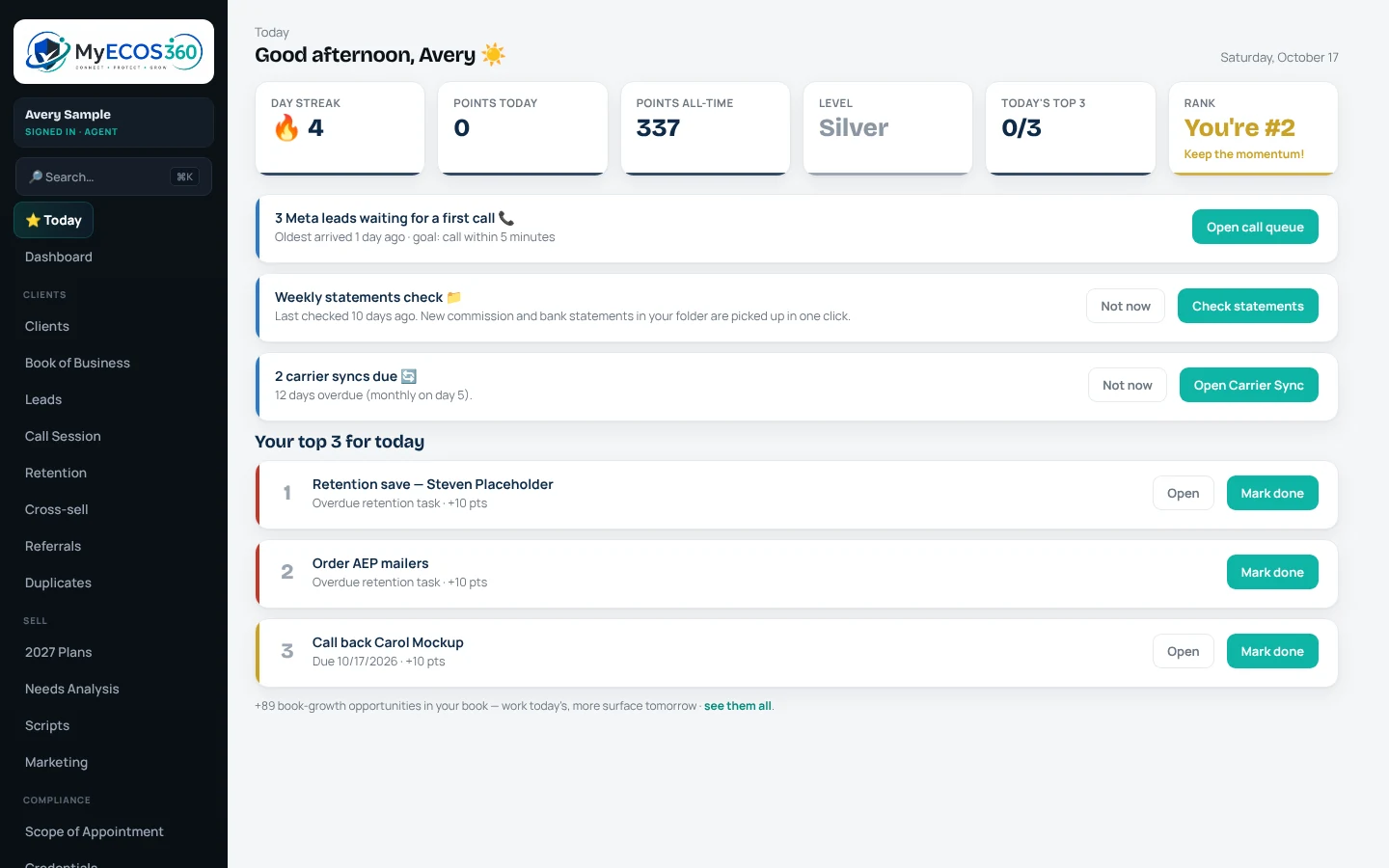
Today
The daily plan: follow-ups, renewals, birthdays and at-risk clients, already sorted for the morning.
- app.myecos360.com · Book of BusinessSample data
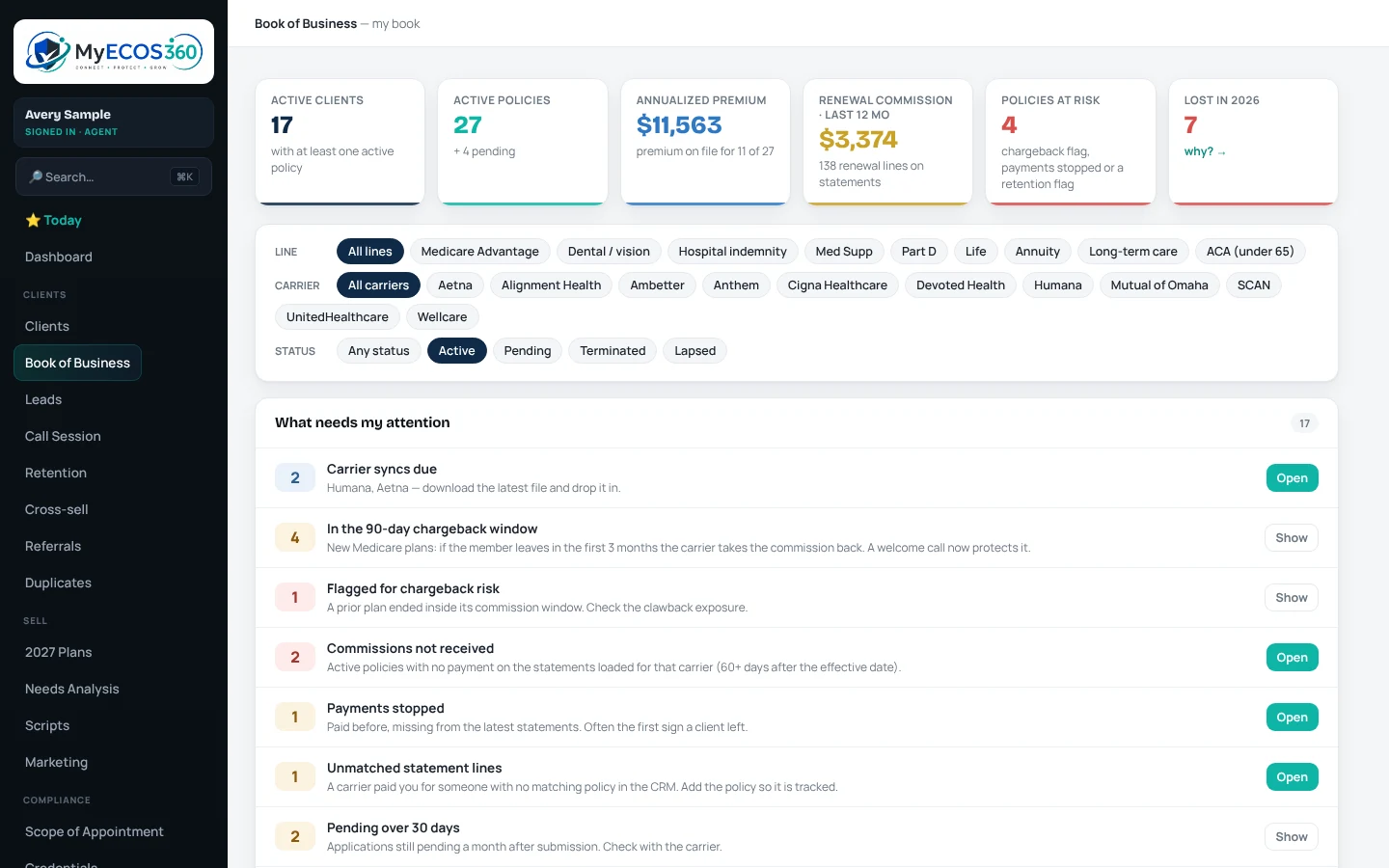
Book of Business
The book an agent owns, by carrier and line, with persistency at a glance.
- app.myecos360.com · Carrier syncSample data
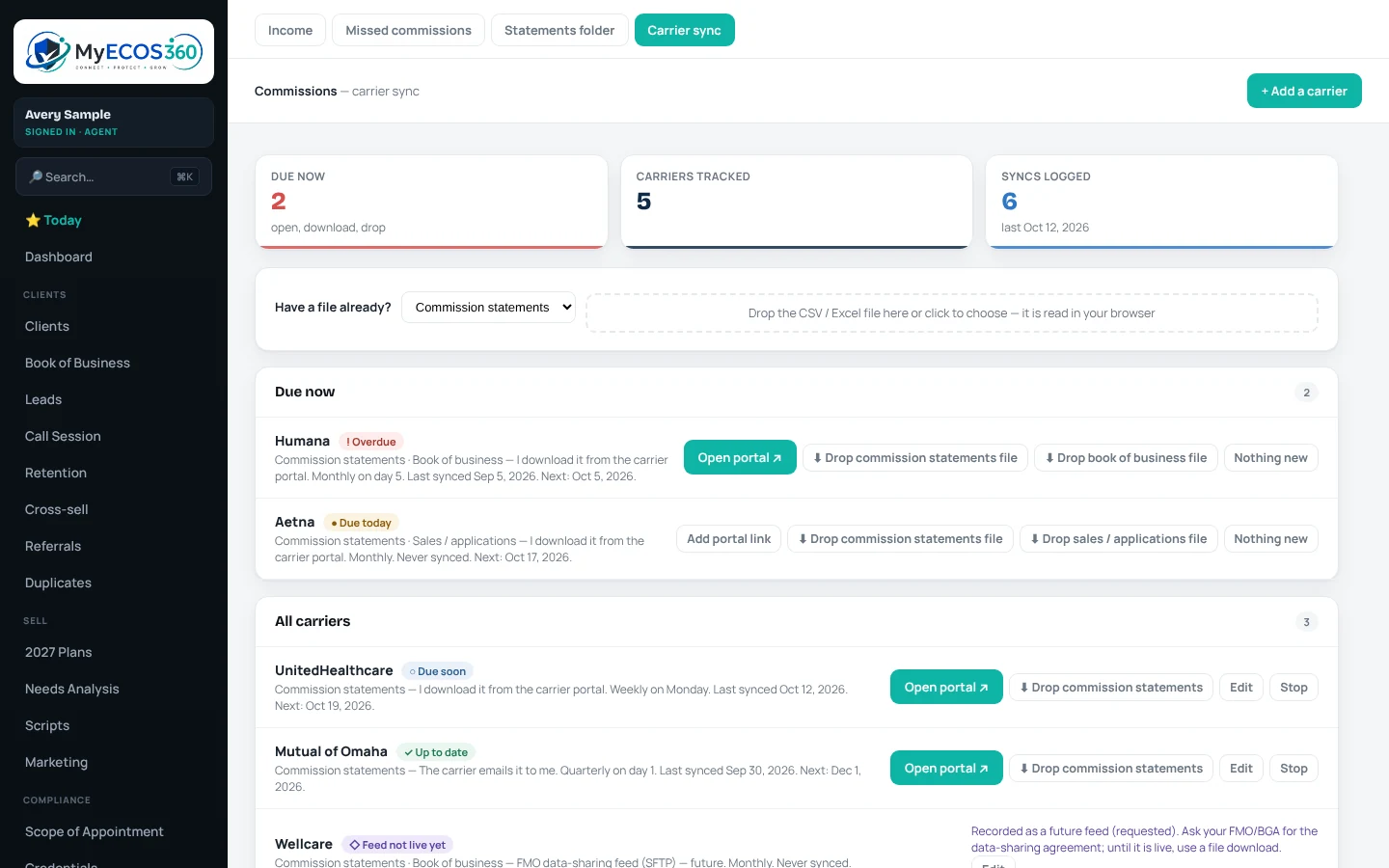
Carrier sync
The sync center that brings carrier data into the CRM, so the book on screen matches the book at the carrier.

Careers at ECOS
Want to be the agent who owns the book?
Licensed or not yet, there is a path in: free exam prep, a mentor, and the same operating system shown on this page.
The MyECOS360 ecosystem
Public framework & tools
Available now
The six-system framework, diagnostic, calculators, and guides on this site — free and ungated.MyECOS360 application
For authorized agents
The authenticated operating application where agency work runs day to day. Agent login.Scale Your Agency Workbook
Available now
The 51-page implementation workbook and Desk Companion — score your six systems and build a 90-day plan. Get the workbook, free for verified agency owners and agents.